

The Romantic revolution: between the Enlightenment machine and the Romantic soul
Welcome to my HIST 224 multimedia portfolio exploring the Romantic Revolution. This website investigates whether Romanticism was a true revolution or an unfinished dream. Through paintings, historical analysis, interactive maps, Gothic literature, personal reflection, photography, poetry, and sound, I examine how Romantic thinkers challenged the Enlightenment’s emphasis on reason by celebrating imagination, emotion, nature, and the sublime.
The Core Inquiry: Revolution of the Spirit

This gallery presents six major Romantic artworks that explore imagination, revolution, nature, the sublime, political struggle, and the Gothic imagination. Together, they demonstrate how Romantic artists challenged Enlightenment rationality by placing emotion, individuality, and human experience at the center of artistic expression. Each work contributes to the broader question explored throughout this project: Was the Romantic Revolution a true revolution or an unfinished dream?
Visual Gallery: A Revolution of the Spirit
Michael Ferber explains that Romanticism was more than an artistic movement; it was a response to the Enlightenment’s emphasis on reason, science, and industrial progress.^1 While the Enlightenment viewed society as something that could be understood through logic and calculation, the Romantics believed that imagination, emotion, spirituality, and individual freedom were equally important.^2 Rather than seeing people as parts of a machine, Romantic thinkers celebrated the human soul and its capacity for creativity, passion, and wonder.^3
The central question of this project is whether the Romantic Revolution truly transformed society or remained an unfinished dream. Although Romanticism inspired new ways of thinking about art, literature, and nature, it did not completely replace industrialization or political systems shaped by the Enlightenment.^4 The disappointment that followed the French Revolution and the growth of factories left many individuals feeling isolated and disconnected.^5 Even so, Romanticism transformed the way people understood themselves by encouraging personal expression, emotional depth, and the search for meaning beyond reason alone.^6
The Romantics believed that nature, the sublime, and imagination revealed truths that could not be measured by science.^7 Through paintings, poetry, literature, and music, they challenged the idea that logic alone could explain the human experience. Their legacy continues today by reminding us that creativity, emotion, and the human spirit remain essential in understanding both history and ourselves.^8
The Third of May 1808 — Francisco Goya
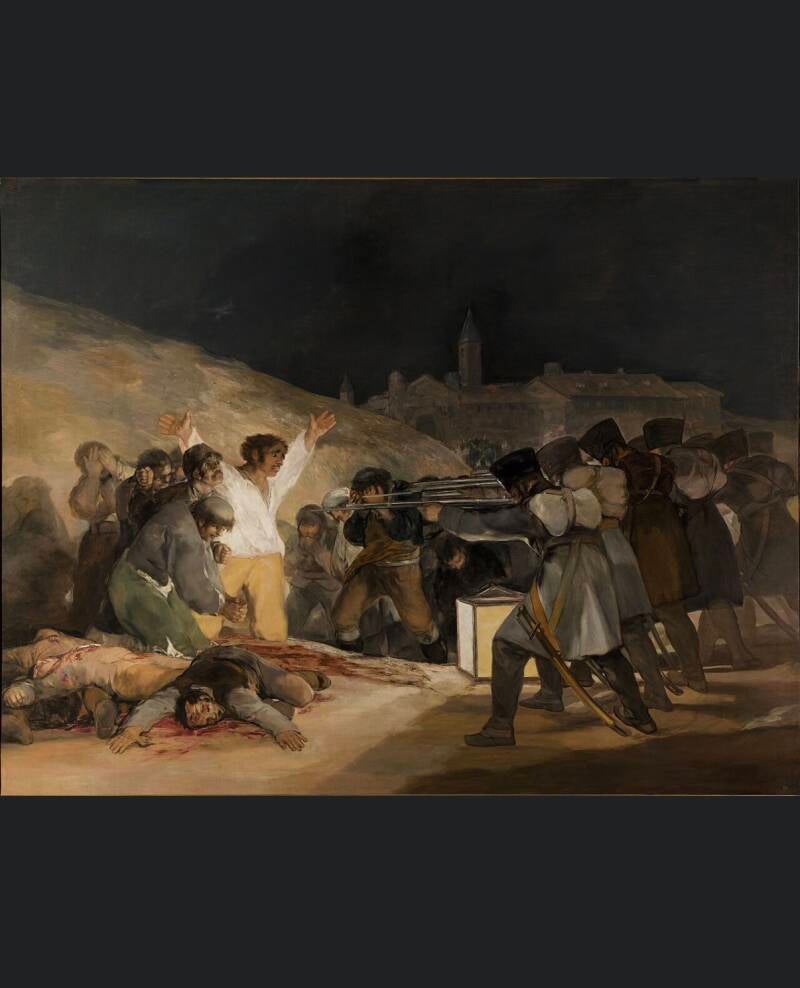
Francisco Goya’s The Third of May 1808 portrays the suffering of ordinary civilians during the Napoleonic Wars. Rather than glorifying battle, Goya focuses on fear, sacrifice, and human suffering. The central figure, dressed in white with raised arms, symbolizes innocence and martyrdom, while the anonymous firing squad represents the brutality of war. By emphasizing emotion over military triumph, the painting reflects the Romantic rejection of Enlightenment ideals that placed excessive faith in reason and progress. Instead, Goya reminds viewers that compassion, individual experience, and moral conscience are essential to understanding history.¹⁰
Interactive Mapping: The Geography of Romanticism
This interactive map traces important locations connected to the "Romantic movement, illustrating how geography influenced Romantic artists, writers, and revolutionary ideas". From the Lake District in England to the Swiss Alps and revolutionary Paris, these locations demonstrate how landscape, history, and political change shaped the Romantic imagination.¹

The Gothic & Irrational
This section explores how Gothic literature and art revealed the darker side of Romanticism. Through folklore, supernatural imagery, and Mary Shelley’s Frankenstein, Romantic writers examined fear, isolation, ambition, and the hidden aspects of human nature. Together, these works demonstrate how the Gothic challenged Enlightenment faith in reason by confronting the irrational and the unknown.²

Folklore as Political Resistance
In Central Europe, invoking supernatural spirits was considered a forbidden act that directly challenged the rational ideals of the Enlightenment. During the nineteenth century, powerful foreign empires attempted to erase Polish identity through censorship, strict political control, and the suppression of local traditions.⁴ In response, Romantic artists and writers used folklore, ghost stories, and ancestral spirits to preserve their nation’s history and cultural identity.
Wojciech Gerson’s The Ghost of Barbara Radziwiłł illustrates this form of resistance. The ghost of Queen Barbara does not submit to imperial authority or foreign rule. Instead, she symbolizes a national spirit that survives even after political conquest. The supernatural becomes a reminder that memory, tradition, and identity cannot be destroyed by laws or military power.⁵
Romantic writers believed that folklore carried the soul of a nation. By preserving legends and ancestral myths, they resisted the cold rationalism of occupying empires and protected the emotional and spiritual foundations of their culture. Although political control could silence governments and institutions, it could not erase the stories, beliefs, and imagination that united the people. Through folklore, Romanticism became both a cultural movement and a peaceful form of political resistance.⁶
Mary Shelley’s
Frankenstein
Manuscript
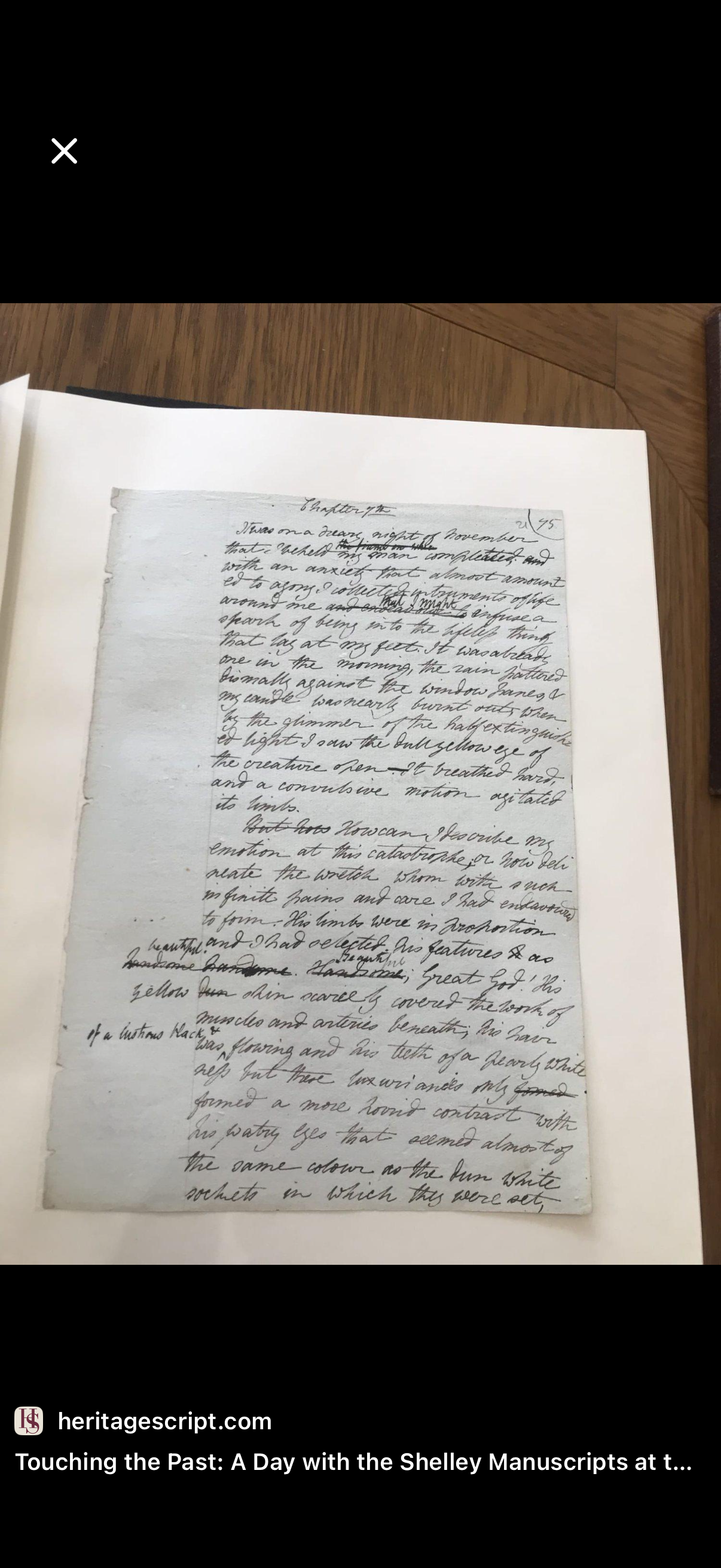
This manuscript page from Mary Shelley’s Frankenstein provides a rare glimpse into the author’s creative process. As a primary historical document, it shows how Shelley revised her ideas while developing one of the defining works of Romantic and Gothic literature. The manuscript illustrates the Romantic emphasis on imagination, individual creativity, and emotional expression, while also revealing how the novel questioned the Enlightenment’s faith in scientific progress and reason.⁷
Nature and the Sublime

Unlike Enlightenment thinkers, who often viewed nature as something to be studied and controlled, Romantic writers believed that nature inspired awe, imagination, and self-reflection. This photograph, taken by the author in Whistler, British Columbia, captures the sense of wonder that Romantic artists described as the sublime. Standing before vast mountains and forests encourages reflection on humanity’s small place within the natural world. By including a contemporary photograph, this project demonstrates that Romantic ideas about nature remain meaningful today and continue to shape personal experiences of beauty, solitude, and emotional connection.⁸
Conclusion: Was the Romantic Revolution a True Revolution?
The Romantic Revolution transformed European culture by challenging the Enlightenment’s exclusive faith in reason. Through painting, literature, political resistance, Gothic imagination, historical documents, and the experience of nature, Romantic thinkers argued that emotion, creativity, memory, and individual experience were equally important in understanding the world. Although the movement did not replace Enlightenment ideals entirely, it permanently changed art, literature, philosophy, and modern culture. The Romantic Revolution therefore represents both a historical transformation and a continuing influence on how people understand themselves and the natural world.⁹
Footnotes
- Michael Ferber, Romanticism: A Very Short Introduction (Oxford: Oxford University Press, 2010), 1.
- Michael Ferber, Romanticism: A Very Short Introduction (Oxford: Oxford University Press, 2010), 81.
- Michael Ferber, Romanticism: A Very Short Introduction (Oxford: Oxford University Press, 2010), 25.
- Zygmunt Krasiński, The Legend of King Sigismund and Barbara, trans. Count de Noailles (London: Ballroom Publishing, 1925), 42.
- Wojciech Gerson, The Ghost of Barbara Radziwiłł, 1886, oil on canvas, National Museum in Warsaw, Warsaw.
- Michael Ferber, Romanticism: A Very Short Introduction (Oxford: Oxford University Press, 2010), 72
- Mary Shelley, Frankenstein manuscript draft, c. 1816–1817, Bodleian Libraries, University of Oxford.
- Photograph taken by the author, Whistler, British Columbia, Canada, 2026.
- Marshall Brown, ed., The Cambridge History of Romanticism (Cambridge: Cambridge University Press, 2010), 18.
- Francisco Goya, The Third of May 1808, 1814, oil on canvas, Museo del Prado, Madrid.
- William Blake, The Ancient of Days, 1794, relief etching, The British Museum, London.
- Eugène Delacroix, Liberty Leading the People, 1830, oil on canvas, Louvre Museum, Paris.
- J. M. W. Turner, The Fighting Temeraire, 1839, oil on canvas, National Gallery, London.
- Caspar David Friedrich, Wanderer Above the Sea of Fog, c. 1818, oil on canvas, Hamburger Kunsthalle, Hamburg.
- Henry Fuseli, The Nightmare, 1781, oil on canvas, Detroit Institute of Arts, Detroit.
Bibliography
Blake, William. The Ancient of Days. 1794. Relief etching. The British Museum, London.
Brown, Marshall, ed. The Cambridge History of Romanticism. Cambridge: Cambridge University Press, 2010.
Delacroix, Eugène. Liberty Leading the People. 1830. Oil on canvas. Louvre Museum, Paris.
Ferber, Michael. Romanticism: A Very Short Introduction. Oxford: Oxford University Press, 2010.
Friedrich, Caspar David. Wanderer Above the Sea of Fog. c. 1818. Oil on canvas. Hamburger Kunsthalle, Hamburg.
Fuseli, Henry. The Nightmare. 1781. Oil on canvas. Detroit Institute of Arts, Detroit.
Gerson, Wojciech. The Ghost of Barbara Radziwiłł. 1886. Oil on canvas. National Museum in Warsaw, Warsaw.
Goya, Francisco. The Third of May 1808. 1814. Oil on canvas. Museo del Prado, Madrid.
Krasiński, Zygmunt. The Legend of King Sigismund and Barbara. Translated by Count de Noailles. London: Ballroom Publishing, 1925.
Shelley, Mary. Frankenstein; or, The Modern Prometheus. London: Lackington, Hughes, Harding, Mavor & Jones, 1818.
Shelley, Mary. Frankenstein manuscript draft. c. 1816–1817. Bodleian Libraries, University of Oxford.
Turner, J. M. W. The Fighting Temeraire. 1839. Oil on canvas. National Gallery, London.
Photograph by the author. Whistler, British Columbia, Canada. 2026.
About This Academic Project
This multimedia website was created for HIST 224 at Alexander College, Burnaby Campus, British Columbia, Canada. It explores the Romantic Revolution through historical research, visual analysis, interactive mapping, primary sources, literature, photography, poetry, and sound. By combining paintings, historical documents, personal reflection, and multimedia elements, this project examines whether Romanticism represented a true revolution of the human spirit or an unfinished dream. Through these interconnected themes, the website demonstrates how Romantic thinkers challenged Enlightenment ideals by emphasizing imagination, emotion, nature, individuality, and the sublime.
Inderjit Singh and Jaismeen kaur
Connect with the Romantic Revolution
Alexander college, Burnaby Campus
Burnaby, British Columbia, Canada V3T 0A3
For inquiries, please contact [[email]] or visit [[website]].